Mediocre Meanderings has long been a title I thought I would use if I ever started a blog. My intention is to share my thoughts, impressions, musings, poetry, and whatever else comes to mind.
Author: sparedbygrace@yahoo.com
I am Richard Brewer—a Christ-follower, psychologist, husband, father, grandfather (Papa) sometimes writer, and lifelong student of people.
For much of my professional life, I've had the privilege of sitting with people as they wrestle with some of life's most difficult questions—questions about faith, suffering, grief, relationships, identity, failure, hope, and what it means to live well.
Those conversations have changed the way I see people and the way I understand my own faith. They have taught me that life is rarely as simple as our explanations of it, that people are almost always more complicated than they appear, and that sometimes the wisest response to a difficult question is to empathize and to keep asking better questions.
I am a committed Christ-follower, but I am not interested in pretending that Christianity eliminates mystery or that faith means having an answer for everything. Faith invites us to pursue truth honestly, to think deeply, to acknowledge what we do not know, and ultimately to trust the God we do know.
Mediocre Meanderings is where I explore some of those questions.
I write about faith and psychology, grief and suffering, leadership and relationships, aging and ordinary life—and occasionally whatever else catches my attention along the way.
I do not write from the perspective of someone who has figured life out. I write as someone who has lived enough of it to know that I have not.
These are my thoughts, questions, observations, and occasional attempts at wisdom. Take what is useful. Challenge what is not. And, if you would like, meander along with me.
Homonym/antonym: Faith in action/ faith inaction. Pretty
much sums it up. There is no in-between. Is faith inaction the lukewarm that
gets spewed out? Paul states in Philippians 2:2-14, “Therefore, my dear
friends, as you have always obeyed—not only in my presence, but now much more
in my absence—continue to work out your salvation with fear and trembling, for
it is God who works in you to will and to act in order to fulfill his good
purpose” (NIV).
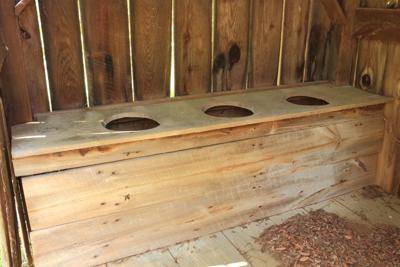
I remember that outhouse very well. For some reason, it had three holes. Confusing to a little tyke. It was oddly fascinating to me that the woman went together. I am not apt to want to share private moments like that with one or more other guys. But the women did. Company and conversation, I guess. Conversation is best had, in my humble opinion, in the house or other places.
I remember being troubled as to which hole I should use. Only two would have posed lesser a problem. One could have been designated for number one toilet function and the other for number two. There were no number threes that I knew about. What might I have been missing? I settled on the one in the middle for the sitting down function. Farther away from the sides with cobwebs and other varmints. I think I may have taken turns with the outside holes for the standup function. But, being a boy also allowed the prerogative of standing on the porch, standing near a tree, or whatever out of the view of others places that might be available.
I remember puzzling about the three holes a lot. I know that says something about me. I was anxious. I had a degree of OCD. Without much more to do at my grandparent’s house (it was not kid friendly) I was obsessed with the number of holes in the outhouse. I think I may have figured out the rationale, but I never asked to have it verified. I had asked what was done with the stuff in the baskets. “I dig a deep hole and bury it”, stated my grandfather. Lesser often to dig, I surmised. Not a job I would have liked. Nowadays it would be possible to star on a TV show doing such a job.
I remember a lot of things about the outhouse. No corn cobs, though I had heard stories of them. But there were Sears and Roebuck catalogs. The pages were not user friendly. I preferred them as Christmas “wish books”. Toilet paper eventually replaced the catalogs. That was a relief. I am not sure there is any particular moral lessen in the memories. But there might just be. I will let you decide.
My grandparents did not have all “modern” amenities until I
was 17 years old. The outhouse was last of the pre-modern amenities to become obsolete.
My grandfather had conceded to move beyond the well and hand pumps about a year
earlier because “idiots” had connected to city water and had begun to use their
wells as septic tanks. You can understand why he opted to join the ranks of
paying for piped in water. Who wants to risk drinking polluted water? But he
was none too happy about it.
Next came the demise of the outdoor toilet. It was not by my grandfather’s choice. Who would think of going to the toilet in the house!?! The outhouse had served people well for untold numbers of years. However, the city mandated it, and he was forced to comply. I was glad he did. I hated the outdoor toilet. The smell was bad. It was hot in the summer inhabited by flies, wasps, other bugs, and occasional snakes. It was freezing in the winter time. I have a pretty good idea where the phrase about subjecting one’s posterior to frostbite might have originated. The only upside to winter time was the absence of insects and other varmints. The outhouse, a visit out of necessity.
My younger brother was even more resistant to the idea of
visiting the outhouse than was I. Visits to our grandparents were often a week
in length. So, it is a long time to go to not go. My brother would get constipated
because he delayed the inevitable. I remember our mother urging him to go. My
grandmother chimed in, too. “Stevie, you just have to go out there, sit there,
and think about it.” I do not think she was fully aware of why he was so
reluctant. The toilet was a foreboding place. If simply thinking had been all
the was necessary, he could have pre-prepared and been very ready to go when
his rear hit the cutout.
Anyway, the sign in the men’s bathroom brought back that
memory. Inspirational sign, indeed. Believing you can, and then putting forth
effort, can prevent all types of constipation. What do you and I need to think
about and believe?
I was somewhere around 4 or 5. I do not recall who all were
there; but I know my uncle, my cousin, and I were there. There were likely
others, perhaps as many as four more (two brothers and two more cousins). We
were leaving the farm house where my uncle lived. We were in his station wagon
and headed down a gravel road. Almost immediately after leaving the house, he
drove off the side of the road, and the car was stuck in the ditch. Try as he
might, he could not get out. He recited several colorful words and walked back
to the house. It was not long before he returned with a farm truck. He
connected the two vehicles with a chain. He directed my cousin to sit behind
the wheel, to put the car in gear, and step on the accelerator when the chain
was tight.
I could see from the back seat that she had stepped on the brake.
I “knew” it was the brake and said nothing (my shyness and inhibition). The car
would not budge. My uncle came back to the car spewing additional colorful words.
“Did you push the gas like I told you?” My cousin responded in the affirmative,
though I “knew” she had been pressing the brake. My uncle gave the same
instructions and back to the truck to try again while continuing to spew
profanities. The same outcome: the car did not budge. Rather, the brace on the
back of the farm truck broke. My uncle was livid. More profanity. My vocabulary
for unapproved words expanded that day.
My uncle removed the chain, drove the truck back to the barn and came back with a tractor. The chain was attached. The same instructions were given and my cousin, again, pushed on the brake. This time, however, the car came out the ditch. It was dragged with the brakes applied. I can almost hear the tires skidding through the gravel.
The chain was unattached, the tractor returned, my uncle
back to the car, and we were on our way. My uncle was puzzled as to how the car
was so stuck it could not be pulled out of the ditch more easily. I “knew”, but
never said a word. I assume my cousin truly believed she was pushing on the gas
pedal. Regardless, we were on our way.
I have thought of that event on several occasions through the years. It came to mind yesterday morning while listening to a sermon. I wonder how often I have pushed on the brake pedal vs. the accelerator. Often, or so I suspect. Feelings of inferiority, unhealthy comparison to others, a sense of worthlessness. Where did those conclusions come from? Certainly not from God. I still am cautious. I still know the difference between the accelerator and brake pedal. But if I am not careful, I apply the brake vs. the accelerator.
Streetlights are wonderful. Yet, they can be problematic. They help me see things I need to see. They also present an obstacle to seeing what I need, or would like, to see. For instance, there is so much light pollution that I am prevented from seeing some of the wonders of the night. Places where there is significant darkness are hard to discover without taking a long drive. No more lying in the back yard to be amazed by stars and constellations.
Many have heard the story about the man who was “tripped up” by the streetlight. The story goes that he was searching frantically under a streetlight. A passerby noted his frantic search and offered to help find the lost article, whatever it was. The passerby stated “It is obvious that you have lost something. I would like to help. What is it you are looking for and where exactly did you lose it?” The man stopped his frantic search just long enough to answer “my wallet” and “I lost it over there” as he pointed into the darkness. The passerby, puzzled as well as astonished responded “Why are you looking under the streetlight?” The man quickly responded “The light is better here.”
Certainly a silly story and, seemingly, not likely to happen. But, it really does happen, at least in a fashion, in many respects, and on a regular basis; or so I suspect. Consider how we deal with certain problems and/or dilemmas. We look for a solution while staying under the streetlight. But, the solution is not there. Rather, the solution is in the unexplored darkness, where the light is not so good. We must be willing to move beyond the “safety and security” of the streetlight into the realm where a solution can be found. It takes courage. The streetlight is familiar, seemingly safe, and seemingly the best place to search for the solution. But, staying under the streetlight may just preclude finding the “lost wallet”. Think about. There are times when I must wander from the “illumination” of the streetlight.
I have had people get my goat. I have known people who have had their goats gotten. My goat has been gotten by certain goat-getters several times. I have known people who have had their goats gotten by certain goat-getters multiple times, too. That realization got me to thinking. How is it that most of the time I let my goat get gotten by the same goat-getter? How is it that other people repeatedly get their goat gotten by the same goat-getters? Why not just put up a sign: “Please get my goat. It is yours to get.” Others should also put up such signs: “My goat to be gotten, help yourself.”
It really is quite foolish to allow my goat to be gotten on such a regular basis. I should take better care of my goat. Afterall, my goat is valuable. My goat is not to be gotten because I depend upon my goat for calmness. I should, therefore, respect and guard my goat. If I do not, then it is my bad that my goat continues to be gotten. Get that?
According to https://www.wideopenpets.com/got-your-goat-the-origins-of-this-funny-phrase/ “The expression ‘got your goat’ means to anger or upset someone — throwing someone off his or her game. But where did this unique expression come from? There are two supported theories, and yes, both involve actual goats. According to The Phrase Finder, the most common theory also involves horses, and says that the phrase originated at a time when goats were used as companions to calm high-strung racehorses. ‘When ne’er-do-wells who wanted the horse to race badly removed it, i.e. they got someone’s goat, the horse became unsettled and ran badly. Others believe the phrase originated from cows, not horses, due to an old belief that keeping a goat in the barn had a calming effect on the cows, who would then produce more milk. Thus, an enemy ‘getting one’s goat’ would upset the cows and cause them to be less productive.”
So, there you have it. Be mindful that some would like to get your goat and my goat. Stop allowing it. Stop being an accomplice to them. Keep your goat so you can keep your composure. We should not allow our goats to be gotten repeatedly by those dastardly goat-getters. Think about it! How often have you willingly allowed your goat to be gotten and it did not have to happen? The goat to be protected is yours. Serve your goat well!!
I read the following quote by Aristotle, several years ago, in a student submitted paper, “I count him braver who overcomes his desires than him who conquers his enemies, for the hardest victory is over self”. Thought provoking in many areas. Conquering my enemies can seem very desirable. It is easy for me to desire vengeance. But I have been repeatedly reminded that… “vengeance is mine, I will repay says the Lord”: Romans 12:19. Prayers appreciated as I seek the high road.
Already. And, not yet.
More to come.
More will be.
Recovering.
Not recovered.
Process and progress.
Processed and progressed.
But, not done.
Even though already.
Not without pain.
Intention and effort.
Both required.
Disconcerting and comforting.
Odd bedfellows, they.
But, they come together.
Kind of like gametes.
One is insufficient without the other.
They start small and gestate.
All that will be, or can be,
In that one small zygote.
Who says a watched pot never boils?
It does if you put it over heat.












 Mediocre Meandering