I will continue…

I entitled my blog Mediocre Meanderings. As such, I do not claim credentials that qualify me as an expert in everything I write about. Thus, I invite you to consider my meanderings with a “grain of salt” or dismiss them entirely if you wish. Yet, I hope the blogs stimulate some thinking, reflection, and even growth.

I have been a student of the bible and psychology. I have devoted the better part of my life to teaching the subject and practicing the profession. One of my passions has been how the bible, faith, and psychology fit together. My faith and psychology have informed and influenced the other. I am grateful for the journey and for what I have learned. Some would talk of “integration” of faith and psychology. I prefer to use “infusion” of faith and discipline. My meanderings reflect that understanding and preference.

I remember being sternly warned against majoring in psychology. I was told it was incompatible with being a Christian. I was told it would be like playing in the Devil’s backyard. I am convinced that I was “called” and “led” into psychology. If you knew my story, you might even conclude I was dragged into it.

Any field or discipline can be dangerous. Even the pursuit of religion can be very dangerous. Many have been damaged by the toxic application of psychology. Many have been damaged by the toxic application of faith/theology. I have worked with people damaged by both. My prayer is that I represent both faith and psychology with honor and integrity.

Let me start with this maxim: All truth is God’s truth, no matter where you find it. Moses told the Israelites to “plunder the Egyptians” (Exodus 3:22). He meant they were to take what was useful as they departed the nation of Egypt and entered the wilderness. I have enjoyed “plundering” the nation of psychology. God uses peoples, things, and experiences to accomplish His will. He even used an ass owned by Balaam to communicate truth (Numbers 22:21-39). I figure that if God can use Balaam’s ass to speak truth, then he can use me, too.

I ended my previous blog with “I will continue” my discussion of psychological suffering. And, so I will. Let me begin by saying that emotions/feelings are a part of God’s creation plan. Even God experiences and expresses emotions. He is a God of love. He experiences and expresses love in numerous ways. He experiences jealousy and anger. He is described as experiencing regret. How do we wrap our understanding around that? I plan to share some of my understandings and conclusions.

Psychological suffering?


My friend continued: “What about psychological health? Does the logic surrounding that type follow the same pattern? Are some believers, by virtue of their chemistry or experiences or whatever destined to mind impairment of some type apart from the intervention of a miracle, which we generally regard, don’t we, as the exception to the rule? Somehow it is easier for me to live at peace with God though I have a bum leg or bad ticker than if I feel psychologically fragmented (to use the metaphor of the DVD that, when played, breaks into those odd visual arrays). A couple of years ago when you, blessed you!!!, blessed, blessed you!!!!!, came to my aid in my trauma, you brought great comfort with your counsel concerning my condition (side note: I have not had a repeat of that trauma, but I do feel a lingering fear of living on an edge that can be crossed unexpectedly), but would you say that as with physical health my psychological health may be chronically affected?”

Psychological suffering occurs early in the bible. Adam and Eve suffered for disobeying God. The were ashamed, afraid, and sought to hide from God. Other instances of suffering were not due to a person’s sin, but that God would be glorified. Sounds a bit hard to swallow for those of us of the western mind-set. Consider John 9:1-3: “As he (Jesus) passed by, he saw a man blind from birth. And his disciples asked him, ‘Rabbi, who sinned, this man or his parents, that he was born blind?’” Jesus answered, “It was not that this man sinned, or his parents, but that the works of God might be displayed in him” (ESV). Paul, quite disturbingly challenged the Christian in Romans 5:3-5: “Not only that, but we rejoice in our sufferings, knowing that suffering produces endurance, and endurance produces character, and character produces hope, and hope does not put us to shame, because God’s love has been poured into our hearts through the Holy Spirit who has been given to us” (ESV).

In the Old Testament we repeatedly see suffering. The more obvious include Job, Moses, Hagar, Jacob, Hannah, Naomi, David, Joseph, Daniel, and the “three Hebrew children”, Nebuchadnezzar, Hosea, Esther, and Jeremiah come to mind. In the New Testament we find several who experienced suffering, some very familiar and some quite obscure. I think of Joseph, Mary, John the Baptist, Stephen, Paul, Timothy, others who Paul specifically mentioned. And, of course, we cannot forget Jesus.

Scripture states: “He (Jesus) was despised and rejected by men, a man of sorrows and acquainted with grief and as one from whom men hide their faces he was despised, and we esteemed him not. Surely he has borne our griefs and carried our sorrows; yet we esteemed him stricken, smitten by God, and afflicted. But he was pierced for our transgressions; he was crushed for our iniquities; upon him was the chastisement that brought us peace, and with his wounds we are healed” (Isaiah 53: 3-5, ESV). And, “In the days of his flesh, Jesus offered up prayers and supplications, with loud cries and tears, to him who was able to save him from death, and he was heard because of his reverence. Although he was a son, he learned obedience through what he suffered” (Hebrews 5:7-8, ESV).

I will expand.

Suffering?


I recently received an email from a dear friend of mine, a true brother in the faith. He wrote: “Richard, here’s a question that gnaws on me at times—like right now: I think we would both agree that God desires physical health for each of His creatures (but we also recognize that God doesn’t always get what He wants—e.g., He wishes that none should perish though many do), but we also know that everyone, in one form or another, loses health or never begins with it, and b/c death is certain for all of us, that loss is, in this life anyway, inevitable. Thus, we would conclude that physical health may not be something that God grants.”

I was intrigued by the “gnawing” as experienced by my friend. I found that feeling resonated deeply with me, too. I have suffered some, both physically and psychologically. I know many others who have suffered, too, many more deeply than me. Many of those are people of great faith. They have attested to the value of suffering as means of deepening their relationships and commitments to God. Their experiences resonate with mine. Following is a beginning response to my friend’s email.

I am not convinced God desires health for each of His creatures. “He has told you, O man, what is good; and what does the Lord require of you but to do justice, and to love kindness, and to walk humbly with your God?” Micah 6:8 ESV. I believe this supersedes health (physical and psychological), wealth, and success.

I believe God’s ultimate desire is to be in relationship with us. “And this is eternal life, that they know you, the only true God, and Jesus Christ whom you have sent” (John 17:3, ESV). A sampling of a few other verses, out of many, are supportive of this contention: “Delight yourself in the Lord, and he will give you the desires of your heart” (Psalm 37:4, ESV). “You will seek me and find me, when you seek me with all your heart” (Jeremiah 29:13 ESV). And, “Blessed are those who hunger and thirst for righteousness, for they shall be satisfied” (Matthew 5:6, ESV).

I believe that God, because of our relationship with Him desires our faithfulness (obedience). “As obedient children, do not be conformed to the passions of your former ignorance, but as he who called you is holy, you also be holy in all your conduct, since it is written, “You shall be holy, for I am holy”” (1Peter 1:14, ESV). Consider also, 1 Corinthians 4: 1-2: “This is how one should regard us, as servants of Christ and stewards of the mysteries of God. Moreover, it is required of stewards that they be found faithful” (ESV).

There are many instances of physical and psychological suffering in the pages of the bible. They do not seem to be contrary to God’s will, but rather can serve to lead to a greater depth of faith and dependence upon God. I plan to write more about the value of suffering as well as examples of biblical personalities who suffered.

Safety and trust

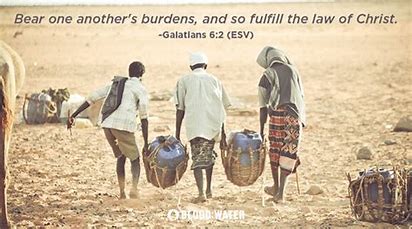
burden

I am a psychologist by profession. Just what does that mean and what do I do? It means that I have spent a great deal of time in school and preparation. It means that I have “earned” a few credentials. It means I have some certificates hanging on my wall. It means I am “supposed” to be an expert when it comes to human behavior and relationships. It means I “counsel” people and assist them in overcoming their concerns, problems, and troubled relationships. It sounds a bit presumptuous.

I suspect. No, I firmly believe, that “if” Christians—those of us who call ourselves Christ-followers lived out our faith, that psychologists and other such helpers would be in far less demand than is the case. What do I mean? Consider Galatians 6:2. “Carry one another’s burdens; in this way you will fulfill the law of Christ” (CSB). What does it mean to carry? It seems clear. We are to share, bear, and assist each other in managing the concerns, pressures, tribulations, temptations, lapses, tragedies, and every other form of struggles with each other. What does Paul mean by “fulfill the law”? Jesus made that clear in Matthew 22: 37-40: “7 He said to him, “Love the Lord your God with all your heart, with all your soul, and with all your mind. This is the greatest and most important command. The second is like it: Love your neighbor as yourself. All the Law and the Prophets depend on these two commands” (CSB).

James 5:16 states: “Therefore, confess your sins to one another and pray for one another, so that you may be healed” (CSB). The “commands” of Paul and James are not possible in too many places and with too many people. For confession to work one must feel safety and be able to trust. How are we doing regarding safety and trust? In my counseling office I assure my clients that confidentiality is guaranteed except in cases where there is intent to harm self or another or if a child or vulnerable adult is being abused. It makes sense. And, it is critical. Christians should set the standard of safety and trust. Too many times a prayer request shared leads to a violation of another person’s secrets. How dare we betray others by not maintaining confidence. Let us all be challenged.

IF


“IF”

“If then”, then that–guaranteed.
“If only”, unchangeable.
Much time ruing “if only”.
“If only” is the response to regret or remorse.
Too much time spent on “if only”.
“If only” doesn’t have to be wasted.
“If only” doesn’t have to be fruitless.
Experience had is experience gained.
Maybe dire consequences.
But, newness is promised.
Hard to comprehend, but “if only” can be a fresh start every time.
I John 1:9.
Not to embrace forgiveness and cleansing is to disbelieve God.
Or, to hold to higher standards than God’s.
Forgiveness.
Restoration.
Cleansing.
From ALL unrighteousness.
God. Unfathomable.
God. Merciful and gracious.
Over and over again.
Help me to embrace but not to abuse.
Jesus stated: If you love Me, then you will keep my commandments.
Jesus stated: My commandments are not burdensome.
If love, then obedience.
If no love “If then” is haunting.
“If only”. “If then”.
Both have value.
“If only” is redeemable because of love.
Richard L. Brewer
08/29/2018

Rue: bitterly regret.

Shadows: we cannot outrun them.

No matter how fast we run, we cannot outrun our shadow. Yet, we tend to try to do so. We expend a tremendous amount of energy. We grow weary. We may cover a lot of ground. But, the shadow is still right there. How can we effectively deal with the shadow? Embrace it. Own it. How do we embrace the shadow? Be honest about it. Recognize it. Feel it. Deal with it. Work through it. It will not go away. The shadow, undealt with, steals energy and life. To embrace the shadow is not just to accept it. To work through it is great gain. The shadow, dealt with, can be a source of shade. It is good to experience the shade of the shadow instead of running from its phantom power. I am reminded of a video I watched of a dog seeking to drink from the shadow of the real stream of water. Energy spent. No satisfying of the thirst. An apt illustration!

The only way not to cast a shadow is to be directly under the Son. He takes the heat. He embraced and embraces all our shadows. He provides the shade.

https://www.youtube.com/watch?v=IzsDuWeg2-c

Negatives


I recently found myself thinking about vintage cameras and the negatives used to make photographs. The negatives were intriguing. I remember looking at the negatives, trying to figure out who and what was in them. The negatives were always interesting and looked quite differently from the “finished” product. So much how we see other people and sometimes self, too. It is very easy to see the negative vs. the developed. I believe we would perceive people kindlier if we knew their stories. Christ takes the negative and develops it. Oh, to be more like Jesus.

Creator??

I recently came across this video. It is thought-provoking and challenging. I have been “steeped” in believing in God since I was a wee bundle of DNA. So, Atheism has never been an option for me. As far as my feeble mind is able to function, it seems to make more sense to profess Gnosticism than Atheism.

There are those who have spent their lifetimes seeking to “prove” the existence or non-existence of God. Each position requires faith. I believe in God. That is where I place my faith. Not only does it make sense, but it provides for values, morals, purpose, and relationship.

Relationship is not very neat. It is messy. My relationship with God has been messy. He has not been messy. I am the one with the limitations. As such, I have had my crises. I have doubted and questioned. I have been contentious with God. If He is omniscient I would have been the one who lost if I had not been honest. He was patient and loved me. Amazing. I would have turned myself into a grease spot. To be honest, I was afraid He would and angry that He did not. He loved me instead. Truly amazing!

Remember, He asked Adam where he was for Adam’s benefit, not His. God knew where Adam was and what Adam had done. God wanted Adam to know where Adam was. God provided and has ever since. I cannot fathom seeking to go it alone and to conclude all is nothing more than random occurrence.


Pederasty

The recent news about sexual abuse against children is significantly disturbing. The Catholic Church does not have a “corner” on this terrible perpetration against children. Denominations of all ilk and sort have their perps. As a practicing psychologist, I have provided counsel to several who have been violated in unspeakable ways. The church and the clergy should be safe and sacred. That is not always the case. Every single element and fiber of one’s being is harmed when so abused. Physical, emotional, relational, cognitive, spiritual: all are impacted. More than one of the “survivors” of the abuse were victimized during scheduled church meeting times. I always cringe when I see a youngster leave a “service” alone. Some I know were abused during what seemed to be a safe “potty break”. Accompany your children, even in church. Urge others to do so, too.

I wrote the following after an earlier focus on abuse by clergy. Perpetrators ” plot and plan”. Perpetrators can appear very caring, charismatic, and pious. Some have been described as the “best we have ever had and can preach like no one we have ever heard”. Wolves can, and do, appear in sheep’s clothing. Asking for forgiveness is insufficient. The cancer must be removed. Ignoring, transferring, failing to warn is a form of collusion.

“If anyone should cause one of these little ones to lose his faith in me, it would be better for that person to have a large millstone tied around his neck and be drowned in the deep sea” Matthew 18:6, GNT.

Prayderist

Pontificating piety.
Practicing pedophilia.
Perpetrating pain.
Priestly pretenders.
Posing.
Parishioners praying.
Packed in pews.
Pederast priest.
Picking, planning.
Plucked.
Ploys and plots.
Purposely piping
Penitent petitions.
Patches of palm
Placed.
Parading , playing
Pliant pray-ers.
Platitudes of Pentecost.
Pitching plans.
Perpetration.
Plotter pinched,
Pleading “no penalty”.
Protesting potently.
Platitudes of penance.
Pretension.
Penitent praying?
Poised to perpetrate!
Penchant for paining.
Purposed proclivity.
Pardoned? Pitiful!

Richard L. Brewer
09.24.10

A pedophile is sexually attracted to children.
A pederast has sex with children.


Refiner, Refinder


Refined:

Refiner, Refined, Refinder, Refinded

The refiner knows when the precious metal has been purified.
The refiner sees his/her reflection in the precious element.
The Refiner of men and women knows when they have been purified.
The Refiner sees His reflection, in them, the precious elements.
The refined become tarnished.
The refined may become lost, but not unrefined.
The refined do not need to re-refined.
The refiner leaves the ninety and nine to search for the lost refined.
The refiner does this any and every time the refined wander.
The refined may need to be found and re-found.
But not re-refined.
The refiner is merciful.
The refiner is faithful to forgive confessed sins and cleanse the refined from all unrighteousness.
The refined and refound are precious in His sight and worthy of His effort.
The refiner seeks and saves those who stray and restores those who have lost their way.
The refiner sought for Adam, even though He knew where Adam, only thought, he was hidden.
The refiner asked, “Adam, where are you”, not for His need, but for Adam’s.
The refiner seeks and calls my name, not for His purpose, but for mine.
The refiner/ refinder, seeks for those who need to be refinded.
Thank God from Whom all blessings flow!
Richard L. Brewer
02/06/2013

Revised 08/17/2018